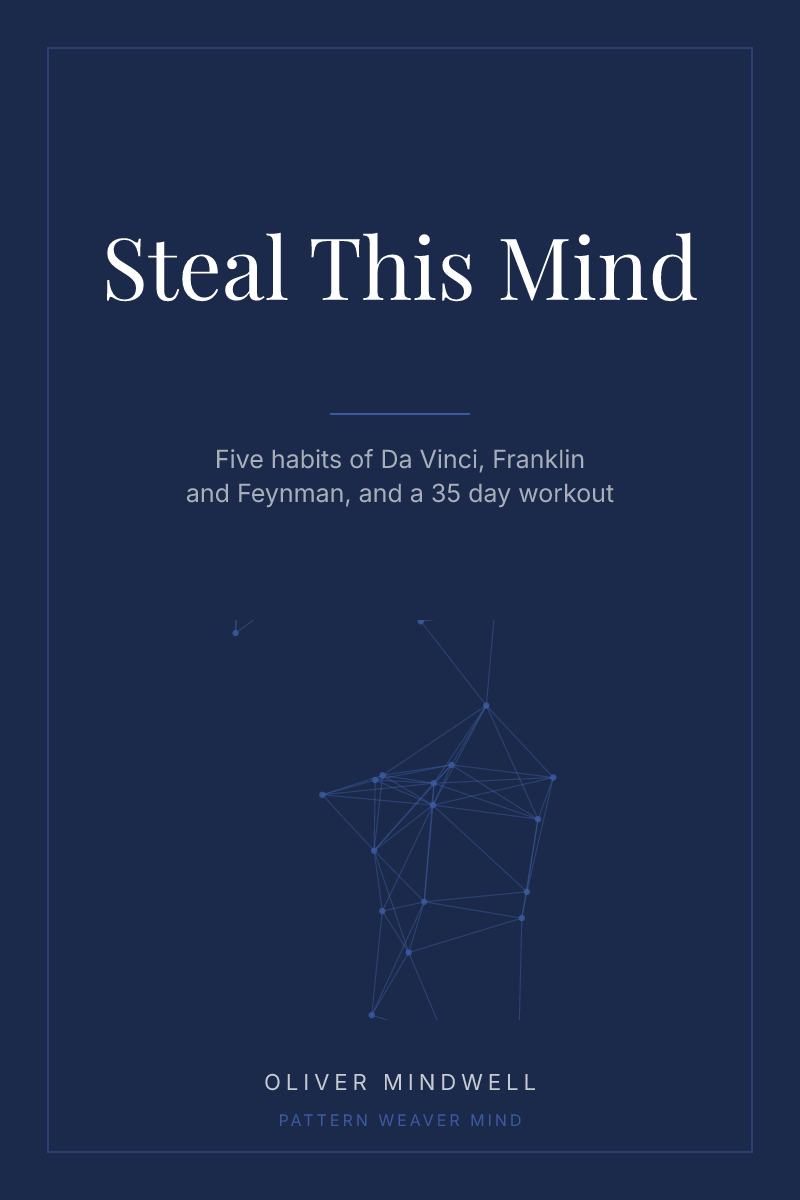
Cover of Steal This Mind by Oliver Mindwell

PDF · 30 pages · 6 × 9 in · printable worksheets

Five habits, thirty five days · A Pattern Weaver guide

Steal This Mind
Five habits of Da Vinci, Franklin and Feynman, and a 35 day workout.

The five habits three famous polymaths actually practised, turned into thirty five days you can run.

$13 USD, plus VAT where applicable, shown before you pay

Instant download, PDF. Secure checkout by Stripe.
Sold by Sanava LTD, Cyprus, published as Oliver Mindwell.

Not ready to buy? The free essay on the same ground costs nothing.

What is actually in it

10 chapters, 30 pages.

Introduction: The word that does the damage.

  1. Habit one: the curiosity list
  2. Habit two: learning by explaining
  3. Habit three: systems of self-improvement
  4. Habit four: cross-pollination
  5. Habit five: play
  6. What they did when it did not work
  7. Adapting the habits to your field
  8. The 35-day workout
  9. Day thirty-six
  10. Common objections

Conclusion: Practice, not talent. Then the Sources chapter, where every source named in the book is listed with a link, and a short note on the author.

The tools

Three tools, and the worksheets to run them.

The five habits

The curiosity list, learning by explaining, systems of self improvement, cross pollination, and play. Each with what it looked like in practice, not in legend.

The 35 day workout

A daily page for every habit, seven days each. Short enough to finish, long enough to change what you reach for.

Day thirty six

What to do when the programme ends, which is the part these books usually skip.

Sources

6 sources, every one a working link. Where a finding has limits or has been revised, the book says so. Not all of them are journal papers, and the chapter says which is which.

The first page

Read the opening before you pay for the rest.

Leonardo da Vinci painted the Mona Lisa, designed flying machines, and dissected human bodies by candlelight to find out how a smile works. Benjamin Franklin printed newspapers, discovered what lightning is made of, and helped write the founding documents of a country. Richard Feynman won a Nobel Prize in physics and played drums in a samba band in Brazil. From the video this guide was written for

We call them geniuses, and the word does a great deal of damage, because it says that what they had was given to them.

It was not. Leonardo da Vinci's notebooks run to thousands of pages, and they are not the notebooks of a man receiving visions. They are the notebooks of a man working: lists, questions, reminders to himself, the word tell me scrawled in the margins. Benjamin Franklin wrote an autobiography largely about the systems he built to improve himself, and was embarrassingly specific about them, down to the ruled columns in his little book. Richard Feynman spent his life insisting that he was not especially clever, only especially curious and unusually willing to look stupid.

That is the opening of 30 pages.
Before you buy

The questions worth asking.

Is this just the video in writing?

Partly, and here is exactly which part. The three tools are the same three tools, because they work. What the video does not have: the worksheets for all three, the full research with every source linked, the original sources from Leonardo's notebooks, Franklin's autobiography and Feynman's own accounts, and a chapter on what they did when it did not work, and the questions there was no room for. If you only wanted the three tools, you already have them, free.

How long is it, really?

30 pages at 6 by 9 inches, about 5,000 words, 10 chapters plus an introduction and a conclusion. It is a short book and it is priced like one. It is not a 300 page business book and it does not pretend to be.

What do I get, and how?

One PDF. The download link appears on the confirmation page the moment the payment clears, and the same link is emailed to you with your invoice. No account, no app, nothing to install. The link does not expire, and if you lose the email you can have it sent again.

Can I print the worksheets?

Yes. The pages are laid out at 6 by 9 inches. The parts you fill in sit inside the chapters they belong to, so you can print just those pages, or the whole book.

Are the sources real, and can I check them?

Every source is named and linked in the Sources chapter, 6 of them in this one, and the links were checked when the book was built. Not all of them are journal papers: some are reference pages, talks, or news write ups of a study, and the chapter says which is which. Where a finding has limits or has been revised, the book says so rather than quoting the headline.

Something went wrong: the file will not open, or I was charged twice.

Reply to the email your invoice came in and it gets fixed, with a fresh link or by refunding a duplicate charge. To be straight with you, that is not a change of mind refund policy. Because the file is delivered the instant you pay, and you confirm that at checkout, the 14 day right of withdrawal does not apply. This is us fixing our own mistakes, which is a different thing.

Practice, not talent.

30 pages, three tools, 6 linked sources. One file, yours to keep.

Instant download, PDF. Secure checkout by Stripe.
Sold by Sanava LTD, Cyprus, published as Oliver Mindwell.

The other twenty-three guides