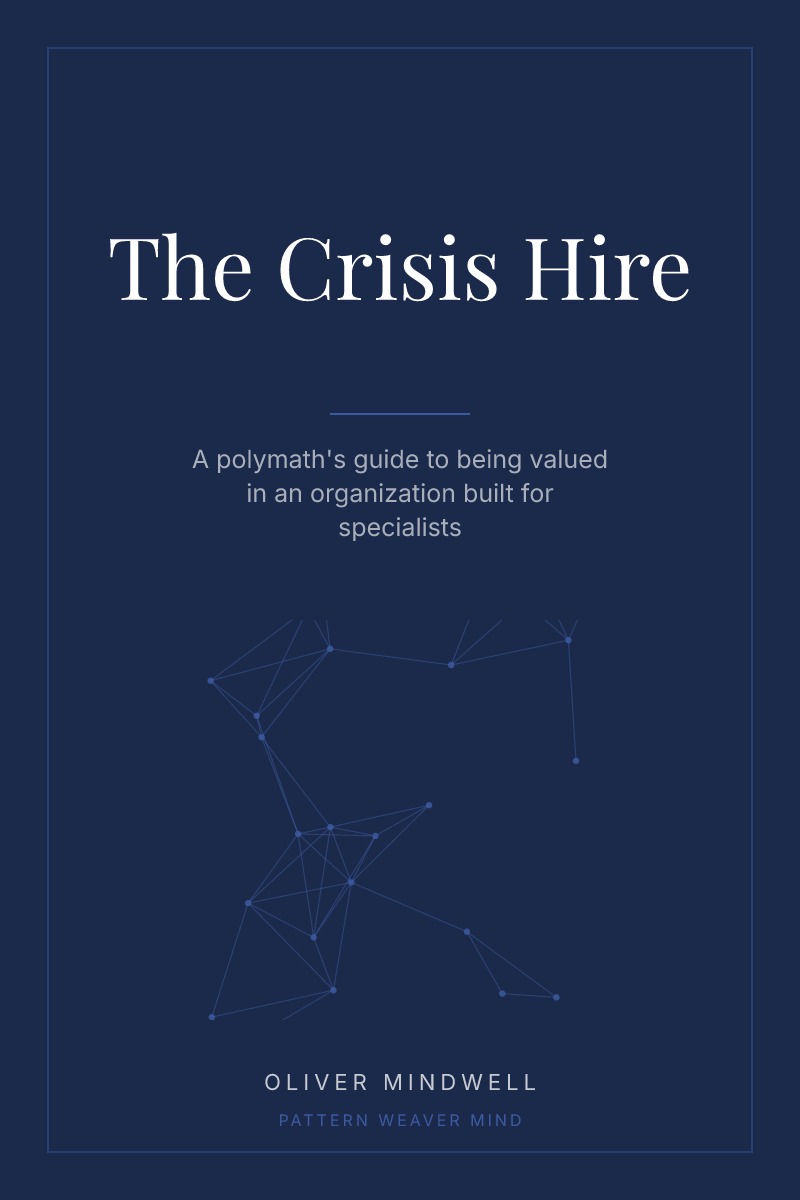
Cover of The Crisis Hire by Oliver Mindwell

PDF · 31 pages · 6 × 9 in

Brilliant, but difficult · A Pattern Weaver guide

The Crisis Hire
A polymath's guide to being valued in an organization built for specialists.

Why a connecting mind fails almost every test a workplace uses to decide who is valuable, why it is the one the workplace calls in a crisis, and six moves for making your value readable from a distance.

$13 USD, plus VAT where applicable, shown before you pay

Instant download, PDF. Secure checkout by Stripe.
Sold by Sanava LTD, Cyprus, published as Oliver Mindwell.

Not ready to buy? The free essay on the same ground costs nothing.

What is actually in it

11 chapters, 31 pages.

Introduction: The sentence in the other room.

  1. The machine that reads people
  2. Reasons one and two: the box and the boredom
  3. Reason three: the fifteen percent
  4. Reasons four and five: Cassandra and the crisis
  5. The one line
  6. The Crisis Ledger
  7. Turning warnings into questions
  8. The autonomy conversation
  9. Reading your organization
  10. The first ninety days
  11. Common objections

Conclusion: Monday after. Then the Sources chapter, where every source named in the book is listed with a link, and a short note on the author.

The tools

Six moves, and when to reach for each.

The one line

The sentence a manager can say about you in a room you are not in: a function, not a title, in plain words a non-specialist could repeat. Twenty worked examples, and how to say it until other people say it for you.

The Crisis Ledger

One line per emergency, written the same day: what broke, who called you, what you did, what it would have cost if you had not, and who else saw it. With witnesses it is evidence, without them a diary.

Turning warnings into questions

A warning makes you the problem; a question that has to be answered makes the problem the problem. Five rewritten pairs, and a one paragraph note sent the same day, so the warning has a date and your name on it.

The autonomy conversation

Word for word, the request for room rather than a raise or a title, starting with "I'm not disengaged. I'm underused." One bounded area for one quarter, reversible and free to grant, and if even that is refused, you have learned something.

The diagnostic

Eight statements about where you work, from whether anyone senior repeats your line to whether the last crisis changed anything. Five or more true and the box can grow; two or fewer and the sentence in the other room is about them, not you.

The first ninety days

A plan for a new role while the box is still soft: listen and map, make one visible connection between two teams, then ask for room before the first review. By day ninety you have a line people repeat and one witnessed win.

Sources

10 sources, every one a working link. Where a finding has limits or has been revised, the book says so. Not all of them are journal papers, and the chapter says which is which.

The first page

Read the opening before you pay for the rest.

There is a sentence that gets said about you in rooms you are not in. It is said by managers, usually with a sigh, usually after a meeting where you asked the question nobody wanted asked. The sentence is: brilliant, but difficult. From the video this guide was written for

There is a sentence that is said about you in rooms you are not in. You will never hear it directly, but you have heard its echo your whole working life: in the project that went to someone else, in the promotion that went to the person who has done one thing for eleven years, in the performance review that praised your contribution and then, in the next paragraph, asked you to focus.

The sentence is: brilliant, but difficult.

And then one Tuesday the system you warned them about breaks, and your phone rings, and for a week you are the most important person in the building.

That is the opening of 31 pages.

Before you buy

The questions worth asking.

Is this just the video in writing?

Partly. The video named the five reasons, from the Illegibility Tax to the Crisis Hire, and sketched five moves. The book takes each further, with every study linked, and gives the finding that cuts against the polymath a section of its own. Then it builds what the video could only mention: the one-line exercise with twenty worked examples, a template for the Crisis Ledger, scripts for turning warnings into questions and for the autonomy conversation, a diagnostic for whether your organization will ever change, a plan for your first ninety days in a new role, and a straight answer to what if you are actually difficult.

How long is it, really?

31 pages at 6 by 9 inches, about 5,000 words, 11 chapters plus an introduction and a conclusion. It is a short book and it is priced like one. It is not a 300 page business book and it does not pretend to be.

What do I get, and how?

One PDF. The download link appears on the confirmation page the moment the payment clears, and the same link is emailed to you with your invoice. No account, no app, nothing to install. The link does not expire, and if you lose the email you can have it sent again.

Are the sources real, and can I check them?

Every source is named and linked in the Sources chapter, 10 of them in this one, and the links were checked when the book was built. Not all of them are journal papers: some are reference pages, talks, or news write ups of a study, and the chapter says which is which. Where a finding has limits or has been revised, the book says so rather than quoting the headline.

Something went wrong: the file will not open, or I was charged twice.

Reply to the email your invoice came in and it gets fixed, with a fresh link or by refunding a duplicate charge. To be straight with you, that is not a change of mind refund policy. Because the file is delivered the instant you pay, and you confirm that at checkout, the 14 day right of withdrawal does not apply. This is us fixing our own mistakes, which is a different thing.

Monday after.

31 pages, six moves, 10 linked sources. One file, yours to keep.

Instant download, PDF. Secure checkout by Stripe.
Sold by Sanava LTD, Cyprus, published as Oliver Mindwell.

The other twenty-three guides